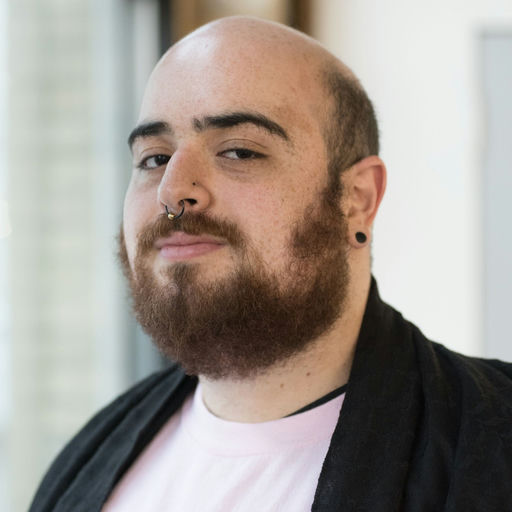
George Abraham (they/he/هو) is a Palestinian American poet, performance artist, and writer from Jacksonville, FL. They are the author of _When the Arab Apocalypse Comes to America _(Haymarket Books, 2026) and _Birthright _(Button Poetry, 2020), which won the Arab American Book Award and the Big Other Book Award in Poetry, and was a finalist for the Lambda Literary Award in Bisexual Poetry. He is also the author of the chapbooks _al youm _(The Atlas Review, 2017), and the specimen's apology (Sibling Rivalry Press, 2019). He is a board member for the Radius of Arab American Writers (RAWI), a recipient of fellowships from The Arab American National Museum, The Boston Foundation, the National Performance Network, and the Map Fund, and more. Their writing has appeared in The Nation, _The American Poetry Review, The Baffler, The Paris Review, Mizna, _and many other journals and anthologies. A graduate of Northwestern University's Litowitz MFA+MA program in Creative Writing, Abraham has taught at Emerson College and Harvard University. He is currently Executive Editor of the Whiting Award winning journal _Mizna. _Their collaborations include co-editing a Palestinian poetry anthology with Noor Hindi titled _HEAVEN LOOKS LIKE US: Palestinian Poetry _(Haymarket Books, May 2025), and a performance art project titled EVE with Fargo Tbakhi. Their work has been translated into Arabic, Farsi, Japanese, Portuguese, Spanish, and more. They currently teach at Amherst College as a Writer-in-Residence.
George Abraham (they/هو) is a Palestinian American poet, essayist, critic, performance artist. They are the author of _When the Arab Apocalypse Comes to America _(Haymarket, 2026) and _Birthright_ (Button Poetry, 2020), which won the Arab American Book Award and was a Lambda Literary Award finalist. They are the Editor-at-Large of _Mizna_, and co-editor of _HEAVEN LOOKS LIKE US: Palestinian Poetry _(Haymarket, 2025) which was long-listed for the Palestine Book Award. They are a graduate of Northwestern’s Litowitz MFA+MA program, and teach at Amherst College as a Writer-in-Residence.
- Diasporic and non-western notions of queerness
- Palestine
- Historical and ancestral memory; disembodied memory
- Invented forms and experimental poetics
- Mental health and intersections with identity
- Disembodied memory
- Bodily trauma & survival
- Spoken word performance
- Artist talks
- Workshops
- Live poetry performances
- Keynote speeches
- Panel discussions
- Class visits
- Commissioned writing
Counter Terrorism with Auto Translate